AI PR reviews that stay useful and stay budgeted.
PURA gives every pull request one clear, focused AI review — routed by your rules, capped by your budget, and run on your own provider keys. Here is everything you get.
Ask for a review. Get one clear answer.
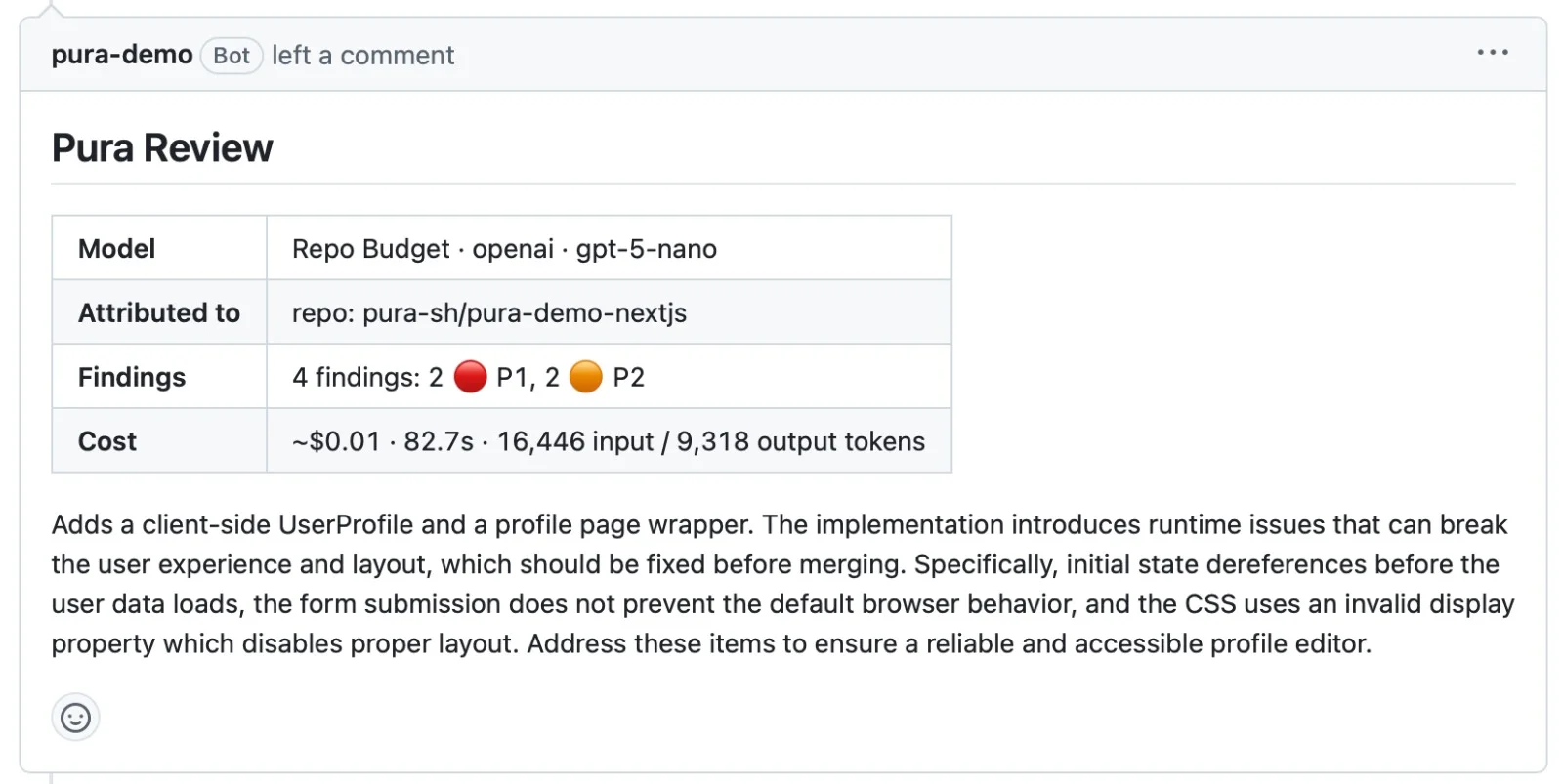
Comment /pura review on any pull request and PURA posts a single, focused review: a summary, findings sorted by priority, and suggested fixes you can apply right in GitHub. A clean PR gets an approve; anything critical asks for changes. Run it again any time by commenting again.
- Trigger a review on demand with a simple comment — no push required
- One review per run, never a wall of bot comments
- Findings ranked by severity (P1 / P2 / P3) — only a P1 requests changes
- Suggested fixes ready to apply directly in GitHub
- Clean PRs get approved automatically
- Re-run any time to get a fresh review on the latest changes
Spend your best AI where it actually matters.
You write the rules in plain English in a SKILL.md review skill. PURA reads each PR against your rules and routes it to the model you picked — send payments, security, and core logic to premium models, and keep doc fixes and dependency bumps on leaner, cheaper ones.
- Write your routing rules in plain English — no config syntax to learn
- Send risky changes to premium models, routine ones to lean models
- Scope agents by team, repo, PR label, or author
- Routing lives in review skills; budgets are set in the dashboard
Use your own provider. PURA never marks up inference.
Connect your Claude, OpenAI, or Gemini account and PURA handles the routing. Your key, your costs, your control.
Your key, your bill
Connect your own Anthropic, OpenAI, or Google account. Inference is billed directly by your provider — PURA never touches the cost or marks it up.
Encrypted at rest
Your API key is encrypted the moment you save it. It is never displayed again after creation and is only used to call your chosen provider.
Claude, OpenAI & Gemini supported
Choose Anthropic's Claude, OpenAI's GPT, or Google's Gemini models. Assign different providers to different review agents to match your team's preferences.
Distribute spend down to the team, repo, and provider.
Set daily, weekly, and monthly budgets at every level — per agent, per team or repo, per provider, even per pull request. PURA spends within each one, and when a budget is reached it fails over to another provider you've added or pauses reviews — never silently blowing past the number.
- Layered budgets: per agent, team, repo, provider, and PR
- Daily, weekly, and monthly — any combination, at any level
- Hit a budget? PURA fails over or pauses — never overspends
- Finance gets predictable AI review costs before the invoice arrives
Budget distribution example
When any cap is reached, PURA fails over to an alternate provider or pauses reviews — it never exceeds the limit.
Agent: payments-team

Primary provider:   Anthropic (Claude)
  → Daily cap reached at $10.

Fallback provider:  OpenAI
  → Daily cap also reached.

Fallback provider:  Gemini
  → Review continues uninterrupted.

If every cap is reached:
  → Reviews pause until the next period.
→ No overspend. Ever.Reviews keep running even when one provider is capped.
Add more than one provider to an agent and PURA automatically continues reviews on the next provider when the primary one hits its budget cap. No manual intervention needed.
- Add multiple providers to any review agent
- Automatic failover when a provider hits its budget cap
- Reviews pause only when all providers in the agent are exhausted
- Spend stays bounded — failover never overrides your caps
See exactly where every dollar of AI review goes.
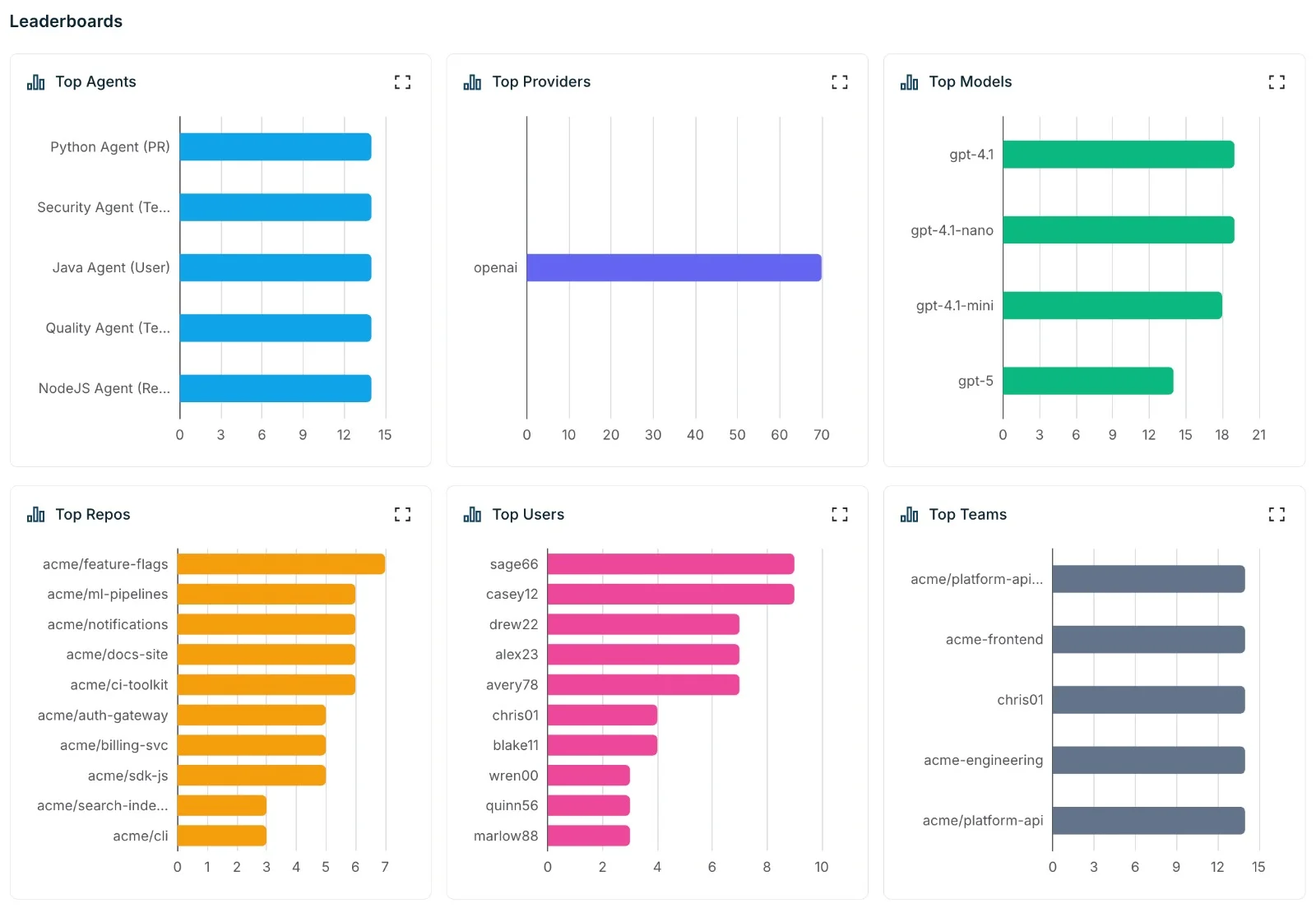
A dashboard that shows total reviews, spend, and tokens at a glance — with budget progress cards and leaderboards so you always know who and what is driving cost.
The analytics dashboard gives you the full picture: budget cards showing daily, weekly, and monthly spend versus your limits, plus leaderboards for top providers, models, repos, users, and teams. Filter by any dimension to find exactly what you need.
- Overview: total reviews, total spend, and tokens used
- Budget cards showing daily, weekly, and monthly spend vs limits
- Filter by date, author, repo, model, provider, agent, or team
- Leaderboards for top providers, models, repos, users, and teams
Built for teams that ask hard questions before buying.
Your keys, your models, and your secrets stay under your control. PURA never stores code or passes raw secrets to an AI model.
Your keys, your models
PURA routes and orchestrates reviews but never owns your inference. You choose which providers and models you trust, and inference runs on your account.
Secrets redacted before the model sees them
PURA scans code for secrets — API keys, tokens, credentials — and redacts high-confidence matches before they are ever sent to the AI model. The finding points to the file and line without echoing the value.
You stay in control
Budgets, provider selection, and review preferences are all in your hands. No opaque defaults and no surprise costs — every decision is yours.
Give your team better reviews. Give your budget a hard stop.
Install PURA, connect your provider keys, and start routing pull requests by your rules and budget today. One comment, one clear review, no surprises on the invoice.
1-month free trial · BYO keys · We never store your code